
Using SEO for leads? Chances are, A.I. has sent them on their way. Images by undraw.co
It's quiet out there. If your business strategy includes drawing new leads from search engines, you may have noticed. Fewer new inquiries, fewer unseasoned customers. Fewer visits to blog posts and pages well-optimized for particular keywords. Those who have managed to find you have somehow made it through definitions, suggested pages, and sponsored content down to the organic results, and then - probably through a few listings, certainly not all the way to page 2; to find you.
With the uninvited rise of AI, search engines have all but abandoned actual website results in favor of efficient self-generated explanations and monetized content. And until this stops efficiently answering questions for users and making money for the search engines, it's here to stay. To make matters worse, the content you set out is likely at least part of what the search engine harvested to come up with its own answer; which stopped it from seeing your website. It's not at all personal, they might say; it's innovation. A.I. answers on search engines are efficient, have at least agreed-upon accuracy, and qualify sponsored content visible above the fold with the answer. And it may keep your SEO from making you another dime.
Gosh - just when we all started to not hate SEO- right?
SEO - beginnings and endings
I'm reminded of Borders and the narrative (made famous by the blockbuster film Sleepless in Seattle) where it came in and drove all the little book stores out of business; but then itself went out of business seemingly by the same forces that stoked its rise. Meanwhile, Barnes and Noble, while subject to the same tides, has outlasted even Amazon (which first came along as a bookstore,) and manages to thrive today while doing something we commonly refer to in this house as "staying in [its] lane." We buy all kinds of things off of Amazon now, things we don't use search engines to find, and Barnes and Noble still caters to the in-person book browsers at its brick and mortar locations.
Do you remember when search engines began? I remember my dad talking about buying stock in Yahoo! and Google because Search Engines were going to be how everyone found information for the rest of their lives. This is still right. Search engines were so good at finding information that it caused fringe information to be authored and published - so the internet became this incredibly flush resource of anything waiting to be found. SEO, the practice, developed from a need to compete to be seen here on any given topic. People who did it, loved it. Nobody else liked it or being outcompeted by it.
Keeping things fresh on search engines involved chasing new rules and algorithm changes over years and years. A well-ranking page needed new backlinks, new structure, new you-name-it in order to stay well-ranking for more than just a minute. It's still this way, but instead of needing to be top 10, you need to be top 2 to be seen. Or pay for an ad. You know.
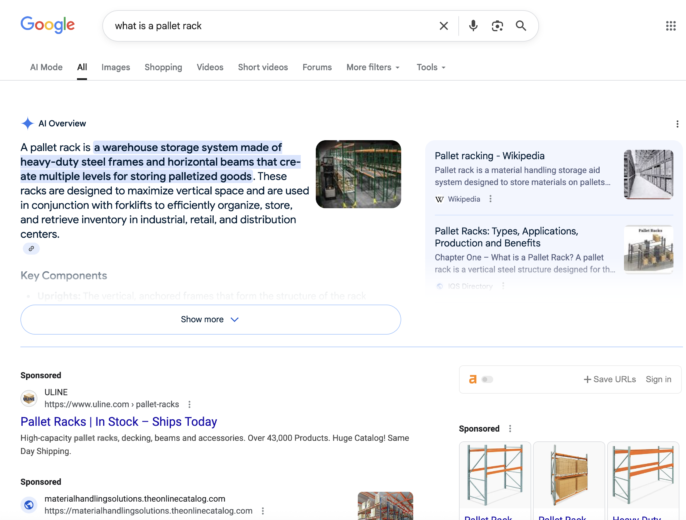
Not only is this answer for "what is a pallet rack" complete enough, but the amount of sponsored content is enough to deter anyone from going further.
One way to compete for a keyword was to answer as many questions about and around it as possible, on blogs or similar pages. Now, asking a question even on a fringe topic, will yield an AI answer and unless for some reason you need more, only one or two sites will be visible as well as a sea of ads. Organic results appear about 3/4 of the way down the page, with only about 4 showing. Unfortunately, this is no longer an efficient way to think about bringing potential customers to a website.
How can websites continue to compete for keywords?
The best way for a website to continue to compete around a keyword is to become entirely about that keyword. If you have multiple focuses (which most websites do,) this isn't feasible. Search Engines will still favor well-optimized pages and well-engineered custom websites over builder websites and junk SEO, but with the way the Search Engine Results Pages (SERPs) have been restructured, the footprint of such work is still diminished by more than 50%, when successful.
When Search Engines began, they revolutionized the internet and the visibility of businesses everywhere. While they're still revolutionizing the internet, they're no longer a place to reasonably compete among websites that have good content. Since they can answer questions themselves and attract ad revenue, the least profitable aspects of their function have been deprioritized.
Does my website still need SEO?
Website features considered to be Search Engine features still need to function, as this is how your website will be displayed if it is found, and relevancy to the Search Engine user is still appropriate. Your website will still be indexed and still be findable - however, your results from them will likely improve after other aspects of user experience and customer support start attracting customers on their own - that is, after you become popular in other ways.
How do I optimize my website, now?
Optimize for humans.
The most valuable way to optimize now is to optimize directly for customers. Yes, dot your i's and cross your t's for crawlers, but no need to revise your pages every month or watch the pulse of SEO results. Instead, focus on assuring your customer has an ideal experience of your website, once they arrive:
- Is your shopping cart clunky?
- Are you losing sales on product pages?
- Can your content be easily found in search boxes?
- Do you get a lot of human emails asking about information that's already published?
- Are executives well informed about the value of the website?
- Do your shipping and taxation systems integrate with your shopping cart in a way that provides.
- Are you watching uptime?
- Are fringe keywords gaining attention for you in ways that you know about?
Knowing what people are on your site to do and helping them do it is an an aspect of white-glove delivery that focus on SEO has frequently permitted to languish as we've moved forward. At Aquarian, we refer to the optimization of the website's experience as CRO and we practice this with our designs.
It may be time to find out how the business best functions with a focus on optimizing for humans. From here, you can place a sponsored ad, if necessary, and get the results you have paid for.
But is SEO dead?
The SEO that used to govern who got seen and when, for what; is no longer effective. Search Engines can still be gamed, but the footprint of those results is no longer a waterfall of potential clients. Ads are the becoming the best way to become seen through Search Engines, and the pay-to-play model that used to go through SEO companies now goes straight through the Search Engines. Websites still need to accurately reflect the content of any given page in titles and meta tags, but it doesn't need to be cleverly revised all the time.
Should I kill my blog?
Absolutely not!! Use your blog to answer actual frequently asked questions of your business, and then direct your customers there when they ask. Use it to record your opinions, projections, dispositions, stake in the game, or whatever else. It's a place to be human now. The SEO-official persona can go. Not only are humans going to be reading it, the more edge-case stuff you post, the more likely you are to be found, ironically, on Search Engines.
It used to be advisable to post to blogs in hopes that someone would care. Now, you're posting to your blog for people who actually do care about the answer and potentially the humans behind it. Keep the blog! We may find that they are more important than they have ever been!
How do I optimize for today's SEO?
Not inspired by the changes to SEO and what it means for your business? Frankly, we don't blame you. You can set up a quick chat with us at no cost and we can talk through ways that your content can make you more money. We'll get through this together!